

Start here
Outcome: a dollar figure for what each won hipages job costs you, and a clear decision on whether to renew. Time: about 30 minutes with three months of invoices (my estimate). Cost: $0.
Do first: find your renewal date, then do the cost-per-won-job sum. Leave for later: comparing lead platforms. The sum works the same on any of them.
Done when: you know your cost per won job, your margin on a typical job, and whether auto-renewal is on.
The email says your hipages membership renews in two weeks. Or your partner, who does the books, has circled the hipages line on the bank statement and asked a fair question: is that actually bringing in work?
The platform shows you the leads you accepted. Whether the monthly fee is paying its way or quietly eating your margin depends on the jobs you won, and those are in your books.
I’m not neutral, so you should know where I stand. I build websites and do local search work for small businesses, which is the “enquiries you own” side of this. I don’t think hipages is a bad deal for everyone, and I’ll say when I think it makes sense.
How does hipages charge tradies?
hipages charges a monthly membership, and each plan comes with a monthly allowance of credits that you spend to accept job leads. It doesn’t take a cut of the jobs: its own FAQ says “hipages do not take a percentage of earnings”. Here are the four standard lead plans as listed on its membership page on 2 October 2026 (there’s also a Pro tier for businesses with 10 or more staff):
| Plan | Price (plus GST) | Credits a month | Directory listing |
|---|---|---|---|
| Starter | $139 a month | 155 | 1 postcode |
| Advanced | $249 a month | 310 | 3 postcodes |
| Premium | $449 a month | 595 | 5 postcodes |
| Platinum | $649 a month | 850 | 10 postcodes |
The membership page says plans start on “a 6 month introductory term”, which then renews on a 12-month term, though the package summary lists 12 months as the minimum for online sign-ups and upgrades. Paying a year upfront gets a 5% discount on a new 12-month subscription.
A lead is a job someone has posted, matched to your trade and area. You see what the job is and where, and you decide whether to spend credits on it. hipages says the number of credits for a lead depends on things like the trade category, where the job is, the size of the job, and supply and demand. Its credits policy adds that the number “can change anytime until the job is marked as hired”.
Then there’s the competition. hipages’ terms say “3 tradies can accept a job lead”, and its business page says to be one of the first three businesses to accept and you’ll get the customer’s contact details straight away. After that you can choose to be waitlisted, and only the homeowner decides whether to connect with waitlisted businesses.
What does a hipages lead cost in dollars?
Roughly 75 to 90 cents a credit before GST, depending on your plan, which puts the leads in hipages’ own example below at somewhere between about $19 and $59. That’s my arithmetic on hipages’ own table: about 90 cents on Starter ($139 for 155 credits), about 80 cents on Advanced, about 75 cents on Premium ($449 for 595) and about 76 cents on Platinum, so the biggest plan isn’t the cheapest per credit. It ignores the bonus and loyalty credits hipages gives longer-term members, which would bring the figure down a little.
hipages’ own lead-credits page gives an example from three nearby Melbourne suburbs: a lead needing 25 credits in Somerton, 31 in Attwood and 66 in Dallas, where the average job size is large. At Starter rates, that’s roughly $22, $28 and $59 a lead before GST. Not outrageous, on its own. And if a lead isn’t fully taken up, the same page says hipages will send it out again after a few hours, often “with credits discounted”, though you shouldn’t see any lead more than twice.
The catch is that you pay for the lead, not the job. A lead is permission to contact someone. Whether they answer, whether they want a quote, and whether they pick you over the other two businesses who also paid is a separate question, and it’s the one that decides whether the fee makes sense.
Try this: go through last month’s accepted leads and write down the credits each one cost (hipages shows the number on each lead invitation). Multiply the total by your plan’s cents-per-credit figure from above. That’s what last month’s leads cost you in dollars, before you won anything.
The number that matters: cost per won job
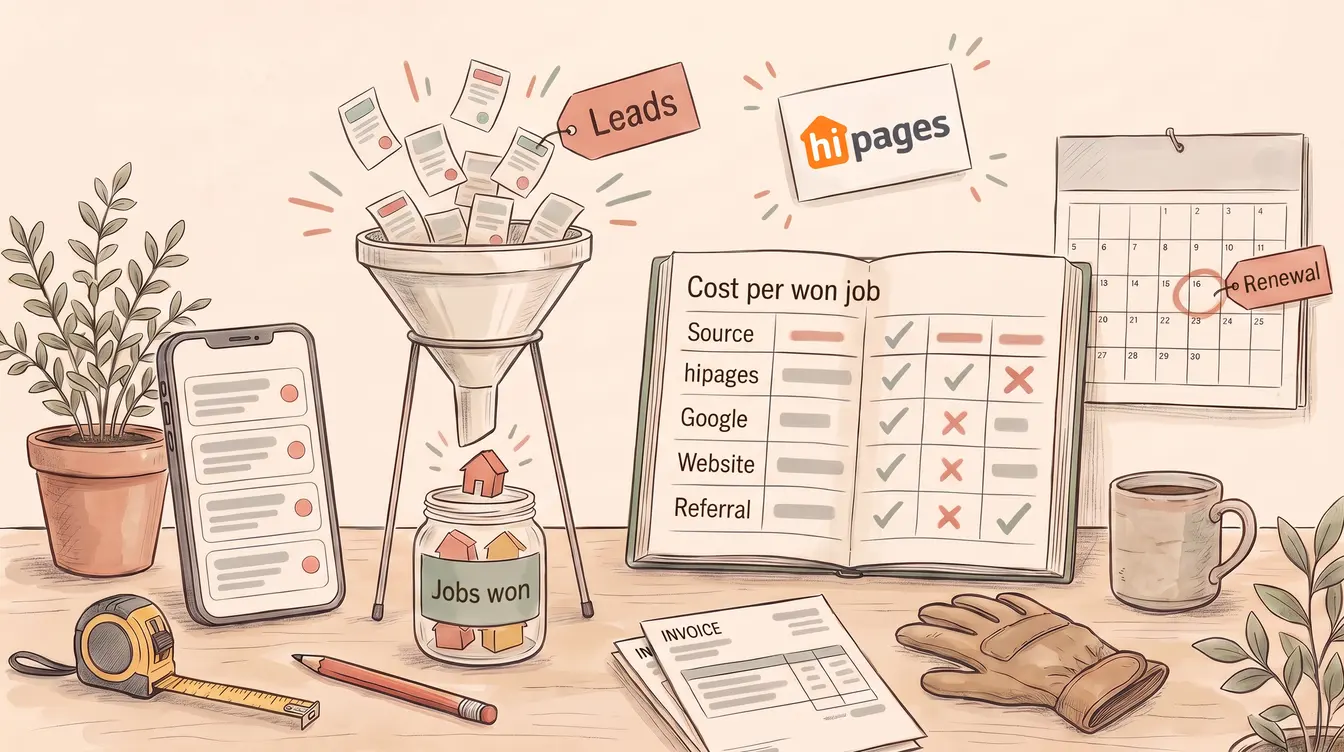
Cost per won job is everything you paid hipages over a period, divided by the jobs you actually got paid for from it.
Use three months, not one, because a single month can be lumpy. Write down:
- What you paid: membership fees for the three months, plus any credit top-ups or add-ons (SMS lead alerts, for example, are $30 a month extra according to hipages’ package summary).
- The leads you accepted, from the app.
- The jobs you won, from your own invoices. Unless you quote and invoice every job through the hipages app, that’s where the real answer is.
- What you make on a typical job: the margin after materials and labour, not the invoice total.
Then divide what you paid by the jobs you won, and put that next to your margin.
Here’s a made-up example, so the sum is easy to follow. Say you’re on Advanced at $249 a month plus GST, so over three months you’ve paid $747 before GST. In that time you accepted 12 leads, got hold of 8 of them, quoted 5 and won 2, which makes your cost per won job $747 divided by 2, or $373.50. If you clear $900 on a typical job, that’s working. If you clear $300, every job you won through hipages cost you more than it made, and that’s before the hours you spent driving to quote the three you didn’t win.
Nobody else can do this sum for you, because nobody else has your won-jobs number: the hipages app only knows about the jobs you run through it. The fix is boring: tag every new job with where it came from.
Try this: add a “Source” column to whatever you use for jobs (a spreadsheet, your invoicing app, the back of the diary). For every new enquiry this month, write where it came from: hipages, Google, website, referral, repeat customer. By the end of next quarter, you’ll have a cost-per-won-job figure you can trust.
What does the hipages contract commit you to?
In short: an intro term that rolls into 12-month renewals, a cooling-off period you give up the moment you accept a lead, and paying out the rest of the term if you want to leave early.
Everything below is from hipages’ own Business Terms (the August 2026 version) and package summary (May 2026), checked on 2 October 2026. The terms say they apply to anyone who joined or renewed on or after 1 June 2026, so if you signed up before that, or on a special offer, your contract may differ: check your key-information or renewal email. None of this is legal advice, and the package summary itself says its cancellation terms are “Subject to your consumer law rights”.
- You start on either a 6-month introductory term or 12 months (hipages’ business page lets you choose, and the package summary lists 12 months as the minimum for online sign-ups). At the end of the term your contract “automatically renews for 12 months”. After that, each renewal is another 12 months. The terms say that at least two weeks before the end of your subscription, “we will remind you by email and SMS”.
- You can turn auto-renewal off whenever you like. The terms say: “You can let us know at any time that you don’t want your subscription to auto-renew, by telephone, email or in app, and we will turn that feature off.”
- There’s a 7-day cooling-off period when you first join and each time your contract renews, with a refund if you cancel in that window and haven’t accepted any leads. Accept one and it’s gone: in hipages’ words, “by accepting a lead you waive your right to the cooling off period.”
- Outside cooling-off, the package summary says a cancellation takes effect at the end of your current term, and to cancel immediately “you’ll need to pay out the remaining minimum monthly charge until the end of your current term.” The Business Terms say hipages may charge an early termination fee equal to the subscription fees for the rest of the term, due on cancellation.
- Pausing is allowed with limits: once for 14 to 31 days on the 6-month term, and up to twice, 62 days in total, on a 12-month term, but not in the last two weeks of a term. Your term is extended by the length of the pause, you can’t accept leads while paused, and the package summary lists “a service fee of $5 + GST per pause”.
- Credits expire. On Starter and Advanced they expire two months after they’re allocated, on Premium and above three months, and any you haven’t used expire at the end of your contract if you don’t renew.
- Bad leads can be reviewed: “You have 7 days from accepting a job lead to request a review”, and if the lead is shown not to be genuine under hipages’ criteria, it gives the credits back.
- Renewing (or joining) also changes how reviews work on your profile. The terms say that if you renew on or after 1 July 2026, your profile moves onto hipages’ new review system (the package summary says joining means accepting it too). hipages will start publishing negative reviews from December 2026, with a right of reply on every review.
None of that is unusual for a subscription, but it does mean the decision point is the renewal date, and the time to do the sum is a month before it, while turning off auto-renewal is still just a phone call or an email.
What are tradies saying about hipages?
If you read the tradie reviews on ProductReview and Trustpilot, the same complaints come up again and again. These are people’s reported experiences, but the pattern is consistent: leads who never answer the phone, or who turn out to be pricing a job they’ll do themselves; more businesses turning up to quote than the three advertised; the credits for similar leads creeping up over a year or two; and trouble getting out of a contract early.
One of those has a partial explanation in hipages’ own terms. Three businesses can accept a lead, but others can join a waitlist, and the homeowner can choose to connect with them, so seeing a fourth ute out the front doesn’t necessarily mean anyone broke the rules. hipages’ replies to complaints on Trustpilot point tradies to its Lead Review Process for leads that aren’t genuine.
My read, for what it’s worth: most of these complaints come back to paying for the contact. If you go in knowing that, and you count your won jobs, you won’t be surprised.
Rented leads vs the enquiries you own
The other way to think about the fee is what you’re left with when you stop paying it. This is my comparison:
| Where the enquiry comes from | Who else gets the same enquiry | What each enquiry costs you | What you keep if you stop paying |
|---|---|---|---|
| A hipages lead | Up to 2 others, plus waitlisted ones the homeowner contacts | Credits, priced per lead | The customers you won (the directory listing goes with the subscription) |
| Your Google Business Profile | Nobody, though competitors show up in the same results | $0 to Google | The profile and reviews, if you control the Google account |
| Your own website | Nobody | Hosting and upkeep | All of it, if the domain is in your name |
| Referrals and repeat customers | Nobody | Your time, maybe a thank-you | All of it |
To be fair to hipages, the two aren’t either-or. Its membership page says you can link your own website from your hipages profile and connect your Google reviews to it, so building your own reviews helps there too.
When does hipages make sense?
It makes most sense when it fills a gap your own channels can’t fill yet, and least sense when you’re paying to quote work you’d have got anyway.
Your situation
- New business, no reviews or website yet
- Big-ticket jobs, where one win covers months of fees
- Small jobs in a suburb with lots of businesses competing
- Diary already full from referrals and repeat work
- You can’t usually respond to a new lead quickly
- You can’t tell which jobs came from hipages
My read
- Can make sense as a bridge for a season, while you build your own reviews and Google profile
- Often worth it, if your cost per won job says so
- Do the sum carefully. The credits for each lead can eat most of the margin on a small job
- Probably not. You’d be paying to quote jobs you can’t take
- Think twice. hipages says the first three businesses to accept get the customer’s details straight away
- Don’t decide yet. Track the source for a quarter, then decide
Before you renew: a 30-minute check
1. Find your renewal date - 5 minutes
Check your hipages account or the last key-information or renewal email for when your current term ends.
Done when: the date is in your calendar, with a reminder a month before it.
2. Count the jobs you won - 10 minutes
Go through three months of your own invoices and mark which jobs came from hipages leads.
Done when: you have a number, even if it’s zero.
Stop if: you genuinely can’t tell which jobs came from where. Start the “Source” column from the cost-per-job section today and come back to this in a quarter.
3. Do the sum - 5 minutes
Add up three months of membership fees and top-ups, and divide by the jobs you won.
Done when: you have a cost per won job in dollars. If you won nothing from hipages in those three months, there’s no sum to do: everything you paid bought no work.
4. Put it next to your margin - 5 minutes
Write down what you clear on a typical job after materials and labour, and compare.
Done when: you can say whether a won hipages job makes or loses money.
5. Decide, and tell hipages if anything changes - 5 minutes
Renew, ask whether you can renew on a smaller plan, pause, or ask hipages to turn off auto-renewal: its terms say it will, and its package summary says a cancellation takes effect at the end of your current term. hipages says you can do that by phone, email or in the app. Missed the date and it’s already renewed? Under the current terms you have 7 days of cooling-off after a renewal, as long as you don’t accept a lead in that time.
Done when: you’ve decided, and if you’re not renewing, hipages has confirmed auto-renewal is off.
Stop if: you’re being asked to pay out the rest of a term and you think the service wasn’t what was described. That’s a consumer-law question, not a spreadsheet one. The small business ombudsman (ASBFEO) helps small businesses with contract disputes, and it’s a sensible first call before you pay.
Fix your own enquiry path before you rent more leads
Whatever you decide about hipages, three things on your own side are cheaper than any lead and keep working when you stop paying for them.
- Your Google Business Profile. Check it shows the right trade, service area, hours and phone number, and that you control the Google account it lives in. If you’re not showing up at all, I’ve covered six reasons a business doesn’t show up on Google, and my local SEO guide covers the rest of the local picture.
- What happens when someone rings or fills in the form. Missed calls with no call-back, a contact form that goes to an old email, a website that doesn’t say which suburbs you cover. Each of those loses an enquiry you didn’t have to pay for. My enquiry leaks checklist goes through them one by one.
- Reviews from customers you already have. Ask every customer for a Google review, not just the ones you know are happy, and don’t offer anything for it: Google’s review policy doesn’t allow businesses to offer incentives such as payment, discounts or free goods in exchange for a review, or to selectively ask only for positive ones. They’re yours, and you can link them to your hipages profile too.
If you’d like someone to look at all of that at once before your renewal, it’s what my Digital Health Check covers: your website and Google profile, and the path from “someone found you” to “someone called”. And if you’re weighing up Google Ads as the alternative, my piece on whether $20 a day is enough for Google Ads does the same kind of sum for clicks.
Tools & Resources
Free tools
- hipages membership costs - the current plans and the subscription FAQ
- hipages lead credits - how credits per lead are set, with the suburb example
- Google Business Profile - check and update your free profile
Checklists & templates
- The cost-per-won-job sheet - four columns for three months: paid (fees + top-ups), leads accepted, jobs won, margin on a typical job. Divide paid by jobs won
- The renewal check - the five steps above, done a month before your renewal date
Further reading
- hipages Business Terms (August 2026) - the contract, including cooling-off, renewal, cancellation and lead review
- hipages package summary (May 2026) - the two-page version, with credit expiry and pause fees
- Enquiry leaks checklist - the places a small-business website loses enquiries